|
Shemini
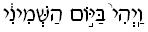
Alien Fire The very title of this parashah warns us that something is different, for it begins with a surprising phrase: "On the eighth day [ Va-y'hi bayom hashmini ] This portion includes the difficult story of the "alien,""strange,"or "foreign"fire offered by Aaron's sons, Nadab and Abihu, an offering that results in their sudden and violent death. Throughout the ages, Torah commentators have wrestled with the meaning of this unexpected and troubling incident. Nadab and Abihu first appear in Exodus 24:1 ( Parashat Mishpatim ) where God invites Moses, Aaron, Nadab, and Abihu, and the elders of Israel to ascend to meet the Eternal God's fire mysteriously appears and the people are overwhelmed. And the text continues, without a break: "Now Aaron's sons Nadab and Abihu each took his fire pan, put fire in it, and laid incense on it; and they offered before the Eternal alien fire, which had not been enjoined upon them. And fire came forth from the Eternal and consumed them; thus they died at the instance of the Eternal"(Leviticus 10:1–2). How are we to read this terrifying passage? Eish zarah , Nehama Leibowitz teaches: "The true motivation of this divine act of retribution has puzzled all our commentators, down the ages."She cites Vayikra Rabbah 20: "For four things did the two sons of Aaron die: For the drawing near, and for the sacrifice, for the strange fire and for not consulting with each other."These two men, who had been privileged to see God face to face, were perhaps so dazzled by the Holy Presence that they thought that they could once again approach the Holy One and present an offering of their own. And in the heat of their passion, they did not even speak to one another about their audacious plan. Leibowitz quotes the Biur: "Nadab and Abihu were religious personalities of the highest order . . . out of a superabundance of joy they lost their heads and entered the Holy of Holies . . . [they] should have been more careful ‘walking humbly before their God' . . . "( Studies in Vayikra/Leviticus [Jerusalem: World Zionist Organization, 1985], p. 66). What is "alien fire"for us? What draws us in with a power so irresistible that we risk our own immolation? How do we distinguish between legitimate and "unfitting"fire? Like Nadab and Abihu, religious leaders throughout history have thought they have been invited to stand in God's presence and then have crossed boundaries that have led them into an inferno. For the Talmudic sage Elisha ben Abuya, alien fire was Greek thought (Jerusalem Talmud, Chagigah 2:1; Babylonian Talmud, Chagigah , 14b–15b). Judaism and Jewish community are sustained by the preservation of boundaries, just as Judaism is sustained by our questioning and wrestling with those boundaries. Tamara Cohn Eskenazi teaches: "Leviticus aims to shape the Israelites into a holy people and to safeguard the purity that it considers essential for contact with the holy. . . . To preserve God's orderly world, where everything has an assigned place, Leviticus specifies what must be done whenever boundaries are wrongfully crossed . . ."( The Torah: A Women's Commentary , p. 567). Our challenge as moderns is to read this deeply troubling tale and attempt to wrest meaning from it. Perhaps the eighth day is the day on which we pose questions—questions that can carry us into and through the fiery words of our beloved text, questions that increase our ability to live in our overheated world, discerning when to approach, when to consult, and when to walk humbly before God. (Return) Rabbi Sue Levi Elwell , Ph.D., serves as the director of the URJ Pennsylvania Council and the Federation of Reform Synagogues of Greater Philadelphia, and as co-president of the Women's Rabbinic Network. |